I wrote a response to the U of O Yoga scandal. If you wanna read it hop over to my new site. ❤

I wrote a response to the U of O Yoga scandal. If you wanna read it hop over to my new site. ❤
 Republished from my new blog: http://www.andigracewrites.com
Last year I published my most widely read piece of writing Why I Stopped Teaching Yoga: My Journey into Spiritual, Political Accountability.
Recently I did an interview on Heart and Spirit, a show on Kootenay Coop Radio, where I spoke about my feelings regarding yoga, my experience as a teacher and community organizer, cultural appropriation, and the importance of connecting to our ancestral roots.
You can listen to that interview here:
As you know my last piece about why I quit teaching yoga was my final piece for this site. I’m going to keep the site online so the piece can continue to be read and shared.
These days I am moving onto a new writing project, one that accompanies my anti-oppressive facilitation offerings as well as tarot card reading.
You can see my latest piece on the new site here:
It’s a letter I wrote to someone with whom I had an interaction with poor consent. It’s not meant as a call out, or to demonize anyone, but rather it turned into something of an open letter for us all to hopefully, learn to hold each better.
If you appreciated my writing on this site, I hope you will also follow my new site.
❤
Over the past few months people have been asking me, “why did you stop writing?”. “Are you teaching anymore?” I got an email from a stranger who asked, “Where did you go?” It’s taken me months to untangle the threads that wove this transformation together. Like most transformations, it runs deep.
After much soul searching, traveling and reflection I can not-so-cautiously say, I don’t teach yoga anymore – and to be honest, there’s not many people who I think should. At least not in the way most of us do now.

I took this photo at my teacher training.
I did my teacher training in 2011. Since becoming an “accredited yoga teacher”, I’ve taught classes in several studios; co-created a social justice based yoga collective that offered yoga on a sliding scale to folks who otherwise might not access it; taught anti-oppression workshops in yoga studios across north America; met and worked with some incredibly inspiring teachers; wrote a reasonably successful blog; had my writing published on many websites – I even planned to open a healing space in my hometown, the un-ceded Coast Salish territories of so-called Vancouver British Columbia.
Through out all of this, I have always had nagging doubts – doubts that became increasingly challenging to ignore. And like Alice, down the rabbit hole, when I followed the tug of those doubts, I came out the other side a truly different person, with some radically different goals in life.
When I first started blogging it didn’t take me long to write a piece that went viral. One of the teachers I most admired was even suggested to me as friend on facebook, because our mutual friend (a prominent yoga blogger) wanted my work to be on his radar. This same piece was shared by one of the political organizers I most admire in Vancouver. It was pretty mind-blowing to me. For such a new teacher, this success definitely came as a surprise. I wanted to write because I wanted to articulate the ideas that were floating around in my head. I didn’t necessarily expect them to be useful or impactful to anyone other than me. It seemed though, that folks who care about yoga and social justice were looking for someone who could articulate the discomfort they felt. Many people told me they found my voice valuable and needed. I felt useful and that felt really good.
This elation quickly faded though, when I started to receive criticisms from folks of colour. I received these critiques both online and in school. At first and still to this day, they arrived in lesser frequency than the waves and waves of compliments I was receiving. But here’s the problem – most of those compliments were from white people. White people, who like me, were not aware (aka. blinded by our privilege) to some glaringly obvious problems in my work. My analysis often failed to meaningfully address colonization and my participation in that oppressive system as a culturally appropriating, white yoga teacher.
When these critiques started coming in I will admit I felt very hurt and this lead me to become defensive. I looked for reasons to dismiss the critiques because they felt painful to look at and inconvenient to consider or process deeply. I was, as most white folks (especially white women) are when we get called out, so wrapped up in how much it hurt to be told I was failing and fucking up – that I used my pain as a reason not to look at my mistakes with the empathy, patience and clarity they needed.
One day, crying in my front yard to one of my best friends I told him, “I just don’t know what to do. I feel like I’m doing the best I can and I just can’t let go of how much this hurts. What should I do?” In his painfully typical, sage and patient way he suggested, “maybe you should focus less on how much this hurts and more on what it was that you did wrong. What was it that you did that made these critiques start coming? Try to shift some of your focus that way and see what answers come.”
Hearing that made me realize what a tremendous (and typical) mistake I was making. I was focusing more on my own pain, privileging my emotional response over the critiques of the very people who I was oppressing. I took some deep breathes, worked to settle my discomfort and started to focus on the work of understanding the critiques.
I started to ask questions. I sent some of the online critiques to other yoga teachers. People whose politics I respected. One after the other, they all told me some variation of, “these people are reacting from a very emotional place. You do good work, just focus on that and keep doing it.” I was literally being told that I should ignore the critiques. That I should “let it go”. And I was told this over and over again no matter who I asked. And as much as this was something a part of me really, really wanted to be able to do, I just couldn’t. I knew I needed to get to the bottom of what these critiques were pointing out.
Eventually in my process of asking everyone I could find whose opinions I respected, I eventually asked a mentor of mine – this time not a yoga teacher, but a well loved and deeply respected facilitator. They kindly and patiently pointed out to me: you’re like the Jackson Katz of yoga. You’re saying things that folks of colour have been saying for a long time. And sure, some white folks are listening to you and that’s good, but it’s reinforcing of your privilege that they are listening to you, when these critiques already existed (and they didn’t say this to me at the time, but really, other people had articulated these ideas a lot better than I had) – and you, a pretty white yoga teacher needed to say them for them to be heard or seen as valuable. Maybe you need to shift your work towards uplifting the voices of people who are already making these critiques? See where that takes you.
The time this person took to offer me this explanation, I realize, was a gift. A really beautiful, valuable challenging gift. Finally, someone was helping me focus more on what I had done wrong, rather than encouraging me to ignore the critiques and just move blindly forward. From there I decided to stop blogging, focus on teaching and facilitating and see what I could learn from stepping out of the online spot-light. Since then I’ve reached some radically different conclusion in terms of how I feel about yoga – which I want to share with all of you.
Before I share what I’ve learned I want to make clear what my intention is in with writing this piece. I’m not trying to attack anyone or take away from the good work people are doing. What I’m suggesting is a re-frame. I’m hoping, that maybe what I’ve written here will spur you to action, but I’m also aware that it might make you feel a lot of emotions, especially if you are a white yoga teacher. It might make you feel angry, sad, hopeless or defensive, but whatever you feel I hope we can share in the journey of diving into deeper accountability together. My hope is that this offering will encourage discussion, bravery, reflection and critique – not tear anyone apart.

Photo I took of the temple and shoes at my teacher training.
I would encourage you to keep in mind that the ideas I’m about to share with you literally took me years to shape in my own head. All the ideas presented here are gestures to some of the meaningful learning I’ve done since I stopped blogging. Lots of conversations, so much reading, travelling, self inquiry and facing some big fears. As such, this blog, while longer than average, is literally just scratching the surface. If you have follow up questions I would encourage you to do some of your own research. Talk to people and ask questions till you get answers that feel right to you. Answers that feel real and bold and brave. And if you need – I would be happy to refer you to resources. What I can’t do, is explain all the ideas presented here in endless detail. It’s a blog piece – I’m inviting you to do some of your own research, reach your own conclusions. See where it takes you.
I also want to make clear that I do and always will, value my yoga practice. It has been in many ways a life raft for me through some of the hardest challenges and deepest healing that I’ve experienced in my life. No matter what happens in the future I know that what I have learned from yoga will always be with me. Being able to feel my body, ground into connection with the earth, introduce breath to places that are tight and hiding, sit through pain and discomfort without immediately reacting – all of these things are lessons that I attribute to my having had practiced yoga for the last ten years of my life. All that said, I can’t take part in yoga the way we share it in the west anymore. It took me along time to admit this to myself and make the necessary changes this realization entails, but what I know in my heart, my mind and my gut is that what we are doing in western yoga is an entitled, willfully ignorant act of theft.
The truth is, I feel, that we are appropriating and destroying the practice that we rely on and love so much. Recently I watched a video produced by SAAPYA titled “We Are Not Exotic, We Are Exhausted: A Film On Being Desi and American, Now”. One of the youth in this video explained this process, from their perspective, much better than I could:
“It’s cultural appropriation with white females, even white males, doing yoga but they don’t even know why they are doing yoga. It’s cultural appropriation because of the fact that it can be turned into a billion dollar industry with these clothes and mats. Yoga isn’t about buying the right things and doing poses. Yeah they say its about reaching, going inside of you to find something spectacular, to find your soul or something. But I don’t think they understand that yoga and finding your soul runs deeper than that.”

Screenshot of SAAPYA’s most recent video.
In many ways, the most challenging part of this learning process for me was coming to terms with the fact that I don’t actually know what yoga is. I thought I did – I thought it was about healing trauma, getting into my body, but I realized that I had been missing the mark completely. I was missing much bigger picture, where some of the most valuble lessons in yoga come from.
A friend of mine, who is of South Asian descent, a woman who grew up practicing yoga her whole life, helped me see that how we practice yoga in the west is a HUGE departure from what it looks like for her and the culture she comes from. She helped me understand that yoga is a multifaceted spiritual practice, philosophical tradition, medicine system and way of life – not an exercise regimen. And when we see it this way, we miss some of yoga deepest teachings.
This same friend used to be part of a teacher training program in Vancouver and was told she needed to teach “our yoga” aka western yoga rather than what she had been taught her whole life. As a result of her refusal to adjust how she teaches she is no longer part of the teaching staff. Can you imagine, a white woman telling someone who has practiced yoga her whole life, that she needs to teach a more Americanized, more white version of a practice that she has practiced her whole life? It’s absurd. This dynamic is exactly why most of us aren’t exposed to any of the philosophical or cultural roots of this practice until we do our teacher training, if we are exposed to this information at all.
What hearing this story taught me is that I don’t and can’t know what yoga’s roots are, because its not part of a culture that I belong to. I could perhaps dedicate my life to learning and unpacking my understanding of yoga, going to India and really digging into that learning, but even that endeavor feels contentious for lots of reasons.
What I’ve come to see is that when I come into a public forum – whether I’m opening a business, teaching a class, writing a blog or speaking in a video – I am claiming that I know and have the right to create what yoga is. This is part and parcel in the process of appropriation and this is part of how we have created what Frank Jude Boccio calls the “yoga industrial complex”. We’ve commodified, materialized and westernized a practice that has roots in a culture that we (and by we I am speaking largely to white folks here) are not a part of. We are taking an aspect of this culture removing it from its context and then we are changing it, claiming to own it, attempting to copyright and sell it and ultimately shaping it into something that is harmful to all of us. However, this harm is unevenly and more deeply experienced by the people from whom we are stealing. Roopa Singh explains this really well when she says:
“What happens when people rely on a country or culture as a panacea for their own wounds with respect to race, lineage, and home? No one comes out of this kind of political or personal violence unscathed, and segregation in yoga is injurious to us all.”
In the time since I stopped blogging I started to re-engage in work resisting industrial expansion – specifically against oil pipelines. One of my most valuable lessons I’ve learned came from time I spent at the Unistoten camp in Northern so-called BC. In the process of working in solidarity with indigenous front line communities, settler folks like me are asked to consider the cultural roots they come from. “Remember, we all come from beautiful origins” is something I’ve heard my friend and mentor Mel Bazil say many times. The process of starting to trace back my family’s origins has lead to me see the way that many European folks have lost touch with exactly what many of us are seeking in our yoga practices. We have become so spiritually hungry and lost we are willing to steal. We feel comfortable doing this because whiteness breeds entitlement – the feeling that it is our right to practice and change a practice that isn’t ours in the first place.

Photo from Unistoten Camp website.
For many white settler folks, whose family lines run back to Europe like mine, the times when we lived in community, on shared lands, in harmony with the moon, the earth and each other are much further behind us than those of the indigenous people whose land we occupy today. This is not to say that these ways only exist in the past, many indigenous communities, despite massive state violence, have maintained or relearned the practices our ancestors worked to destroy. Also many European traditions of witch-craft, herbalism, magic and other land based skills persisted and are still practiced today by European folks. That said, for the majority of us settler folks, we’ve lost touch with the spiritual practices which ground us to place and the natural world. Those spiritual practices were intentionally and often violently stolen from us through the imposition of capitalism, the division of communally held lands, witch hunts and the forced introduction of Christianity. As a result we land where are today: living on lands we don’t have historical or ancestral connections to, with very limited access to spiritual practices that are culturally derived – and this, I feel, is part of what leads so many of us to practice yoga. Not only are we able to heal our bodies physically, we are able to nourish ourselves spiritually. What I would like us to consider though, is that what we are doing to yoga is tantamount to what happened to our ancestor’s spiritual practices. The solution to being spiritually lost is not to steal from others and then claim what we steal for ourselves.
Appropriation is a very difficult and unpopular topic to address in yoga circles. When the wesbite Decolonizing Yoga was launched I was excited, because it meant that perhaps there would be a forum for us to address racism and colonization in the yoga world. And I’m going to be painfully honest here, much to my disappointment I think Decolonizing Yoga has failed to do meaningful decolonizing work. It doesn’t mean that they can’t, but they have a lot of work to do to get there.
Some of my work was up on the site when it first launched and it is where most people came to know my work for the first time. I have considered asking to have my writing taken down from the site many times. When the critiques I mentioned earlier in this piece came in, I sent them to the founder of Decolonizing Yoga, along with some critiques of the site itself. It was brought up to me that the site doesn’t mention the land from which the work on the site was being done – a central and very basic part of decolonizing practice. Further, much like Yoga Journal, none of the content at the time was written by South Asian authors, let alone addressing cultural appropriation. When I brought this up to the founder of the site she told me nothing had been written on the topic that she felt could be posted on the site. I did some research and sent her some articles I thought would be good to post. They weren’t hard to find, just a couple hours on google. One by one she turned each article down. Eventually I posted on my facebook that I was feeling increasingly uncomfortable with the nature of the site. She responded publicly quite politely and as if she was committed to working on improving the site, but in a private message was quite defensive and upset with me for making the post.
This behaviour, I have found, is pretty typical of white yoga teachers – including me. When appropriation is addressed, many of us get defensive. We stop being able to listen. My theory behind why this happens is that we get scared. We rely on our yoga practices to heal our bodies, ease our minds and give us a sense of purpose and spiritual connection. I think the idea of looking at ourselves with a critical lens is scary to us because most of us have no idea what we would do without our yoga practice. And I will admit, it’s been a scary and destabilizing thought for me too, for sure. But I really do believe we can do better than this. We can turn to our own cultural roots to discover practices that build spiritual sustenance. And yes, yoga is a practice that anyone can come to, but I’d encourage you to ask yourself, is the yoga you are practicing a spiritual practice? Or is a glorified fitness regime that is more invested in outwards appearances than deep spiritual work? Because what I know, is that yoga is a practice that can give us deep learning and that most of what we are doing, is running as far a field away from that learning as we can.

Photo from Flick’r
That being said, there are some really amazing teachers and leaders who I feel are doing some essential and game changing work in the western yoga world. These projects consist of people I have learned a lot from who I would encourage all of you to keep an eye on. Check out The Underground Yoga Parlour for Self Knowledge and Social Justice, Total Liberation Yoga, Third Root in Brooklyn and People’s Yoga in East La. And finally I would encourage you to watch South Asian American Perspectives on Yoga in America (SAAPYA) and Roopa Singh. I can confidently say that Roopa is doing some of the most meaningful, spiritually integral and politically brave work that I’ve seen in all my time as a yoga teacher and blogger. Watch her – and do your best to really listen.
I’m going to leave you with a note of painful honesty, because I don’t want to let this go unsaid. This is a community that I have often felt pretty alienated and isolated from. I know I’m not the only yoga teacher out there who cares about social justice and I know that it is not often our intention to stifle these conversations, but the truth is, we do. We often focus more on our latest instagram post of our favourite new pose, than we do on the impact of our actions on the world. I have seen some of the wisest, most thoughtful and inspiring teachers I know leave the yoga world, because their ideas were not well received, because they didn’t want to teach huge vinyasa classes or for very little money – or because they realized that this practice is just not right for them. I would encourage you to not let the people who leave exit your mind quietly. Why are we losing so many teachers and role models who want to challenge systems of oppression? Why do they feel silenced in the yoga community? And beyond that, take note of who isn’t here. Who doesn’t show up to class? Really dig deep and ask yourself why. These questions do not have easy answers.
If the answer seems simple – keep digging.
If these questions make you uncomfortable, don’t turn away – take a deep breath and ask yourself why.
The rabbit hole awaits, and trust me – it’s not as scary as it seems.
This project officially ended in the fall of 2014. In the fall of 2015 I launched my new magic + writing project. If you’d like to follow my current work you can find it at www.andigracewrites.com

Sacred Justice workshop in Kitchener.
Next week I’m traveling down the west coast to take part in UC Berkley’s Yoga and Access conference. I’m very excited to participate in this conference, learn from so many inspiring teachers and meet folks in person who I’ve known online for some time.
While I’m in Cali I’m teaching two workshops. One in Oakland and one in Grass Valley.
The Oakland workshop will take place at Underground Yoga Parlour (3209 Peralta st) on Saturday April 26th. I’ll be co-teaching a consent based yoga class from 11 am to 12:30 pm and then offering a Sacred Justice workshop from 1 to 4. More details are available on facebook. This workshop will be geared mostly towards teachers and studio owners, as an extension of the conversation we’ll be engaging in at the conference.
The Grass Valley workshop will take place at Yoga Well (144 Hughes Rd) on April 29th from 6:00 to 9:00 pm. More details are available on facebook. This workshop is geared towards community members, healers, teachers, therapists, youth, educators, PFLAG folks and yogis and meditators of all stripes.
If you have any questions or would like to request a workshop in your community, please leave a response in the comments section of this post, or send me an email. You can find my email in the contact section of my website.
This is why we need queer yoga. In Vancouver it happens on Thursdays at 6 at 1814 Pandora. ❤
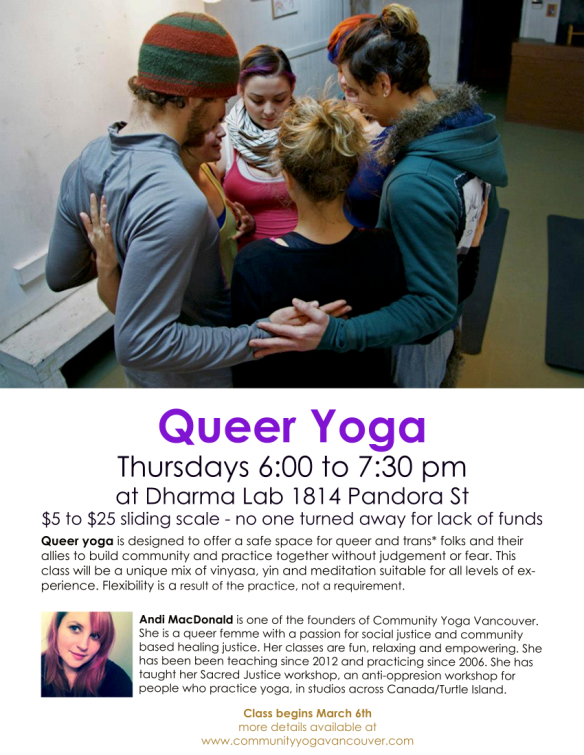

Help spread the word..
Count yourself in and share the event on Facebook.
Invite your friends and loved ones.
Click on the image above and print it off. It’s a poster for the event.

Community Yoga Vancouver
Right now Community Yoga Vancouver is fundraising for our our very own by-donation studio. You can contribute to our campaign and help make our dream a reality here.
Many of us exit space and time entirely during that first savasana. These experiences uniquely prepare us for empathy. Somewhere we realize: everyone has access to this spaciousness, this relaxation, this non-reactivity. But it is an empathy we haven’t the means to share if we’re not behaving like a culture. Ten minutes of camaraderie in the changeroom after a sweaty class will not organize a soup kitchen.
– Matthew Remski in 21st Century Yoga
When I was at my yoga teacher training two summers ago I over heard a conversation between two people in my training. They were discussing acupuncture and how helpful they had found it. I have had chronic muscle tension in my neck and shoulders for most of my adult life, so over hearing this made me wonder if acupuncture might help me. Thing is, acupuncture is expensive, usually running around $80 for a treatment – not something I could ever afford, especially not for more than one treatment.
When I came home from my training I passed by an acupuncture clinic near my house. There was a sign out front that read “Poke Community Acupuncture” and “sliding scale $20 to $40”. I thought to myself, “I can afford to at least try this”. So, I did. Poke is set up with about 8 chairs in the back room and the acupuncturist treats patients one after the other, leaving them to sleep together in the treatment room. Because they treat a patient every 10 minutes Poke can charge much less for each treatment. With a communal treatment room everyone shares in the healing energy of the space, rather than being isolated in separate treatment rooms.
Sitting in the chair, watching the needles poke my skin one by one in a circle across my limbs, I instantly felt relaxed and sleepy. It was similar to how I feel in savasana at the end of my asana practice. I was told I could sleep for my first treatment, but I stayed awake just noticing how it made me feel. About half way through the treatment it felt like a marble rolled out of my shoulder, down my arm and out my middle finger. This was the first time I ever felt that kind of release in my shoulder. I was hooked.

Poke Community Acupuncture in Vancouver
I started volunteering at Poke at the front desk and got free treatments in exchange. I love volunteering at Poke. The space is quiet, calm and beautiful – even while being next to a busy street corner. Poke was my first exposure to a healing space that was truly grounded in a sense of community. We receive our treatments together. We can see each other sleeping. We pool our money and we hold space for ourselves AND the community to rest, relax and heal. When I couldn’t afford $20 for a treatment I was told to keep coming and pay what I could afford. I wasn’t turned away from Poke when I most needed it. I felt like I truly belonged and was valued. There was something brilliant and radical about this.
At some point in my time at Poke I wondered to myself – why had I never felt this way in a yoga studio?
As I started to teach I realized that the model I was seeing in yoga studios really wasn’t serving as many people as it could – especially when I compared it to Poke, where the patients range so drastically in age, race, mobility, sexuality and social status. This diversity is something I have often felt is missing in yoga studios and as a teacher I wondered – how can we make yoga studios more like community acupuncture? What would a yoga studio look like if its goal was to build community, rather than profit?
The more I thought about and researched this idea the more I started to see, there already is a movement to build community in yoga studios – and it’s growing across North America. I wanted a phrase to refer to this movement and lovingly started to call it “community-based yoga”.
From what I can see, community based yoga projects have a few things in common:
By-donation classes
At Community Yoga Vancouver, where I teach, our classes are all by donation. Right now we’re fundraising to open a completely by-donation studio. Bryan Kest, who founded one of the first donation-based yoga studios in North America, wrote a great piece to get teachers thinking about how to offer by-donation classes. Many studios that I would consider to be community oriented offer less than market rate classes.
Safer Space Classes
Studios like Kula Annex in Toronto are introducing classes like queer yoga and brown girls yoga to create safer spaces for people who might not normally feel welcome in regular studios. Similar classes are available at Community Yoga in Vancouver and at Ambaa yoga through Queer Yoga Montreal.
Combining yoga with other sliding scale healing modalities
Hemma in Victoria is a combination community acupuncture clinic and yoga studio. They operate on a sliding scale. Same with the Healing Roots center in Kitchener. Sacred Body Community and Healing Arts Center in Ann Arbor combines yoga with all kinds of sliding scale healing modalities. Same thing with Third Root in Brooklyn.
Crowd funded
If you search “community yoga” on indiegogo lots of campaigns come up. Grow yoga project fundraised to send Angélica De Jesús to a teacher training, with the expressed goal that they would give back to community with more accessible classes when they graduated. Community Yoga Vancouver’s new studio will be crowd funded. Same with The People’s yoga in Oregon and Tri-yoga in Pensylvania.
Consent Cards
Queen St Yoga in Kitchener, Kula Annex in Toronto and Community Yoga Vancouver all use consent cards to allow students to indicate whether they would like to recieve physical assists. This keeps the students safe and opens up communication between the teachers and students that prevent teachers from making assumptions about people’s needs or their bodies.

Community Yoga’s consent cards
Many of the studios listed above embody several or all of these characteristics. What is most noticeable though, is that the goal behind these studios is not to make excessive amounts of profits – but rather to offer yoga to as many people as possible. Accessibility is the bottom line. In these spaces, it seems money is exchanged to keep the spaces open and the teachers paid. We pool our funds collectively to allow community to grow. My feeling is that we do this because we’re stronger supporting each other to heal, rather than doing it all on our own. Community acupuncture recognizes this and slowly yoga is starting to catch on too.
There is a big difference here, I think, between charity and community building. We’re not asking teachers to work for free – which is challenging for anyone struggling to pay rent, as most yoga teachers do. We’re working together to support each other to heal and grow. In the same way an acupuncturist sits in the chair at the end of their shift at a community acupuncture clinic, with community based yoga teachers can take classes in studios that reflect their values and their community connections. We’re creating horizontal networks of community ties and we’re changing what it means to practice yoga in North America.
In my daydreams I wonder if one day all these community based yoga studios will eventually join together to create an organization similar to the People’s Organization of Community Acupuncture. What if we joined all these community-oriented studios together to support each other? What if we shared funds through crowd funding when one of us was threatened with closure? What if we could move from one city to another and know there’s a studio we can land in for instant community? What if we built a movement with yoga and we dared to boldly dream that healing, peace of mind and spiritual growth could be available to anyone who wants it – no matter who they are.

My hope is that you’ll treat this as an introduction to some of the other people and places across North America who feel the same passion you do. An introduction to spaces working tirelessly to keep their doors and hearts open.
Whether we realize it or not – what we’re doing here is building a movement.
One breath at a time.
I want to thank Matthew Remski whose brilliant piece in 21st Century Yoga has been an inspiration to me as I’ve organized with Community Yoga Vancouver. I also want to thank Carol Horton and Roseanne Harvey for putting this brilliant book together.
Community-based yoga studios:
Canada
De La Sol Yoga – Hamilton, On
Healing Roots center – Kitchener, On
Queen St yoga – Kitchener, On
Kula Annex – Toronto, On
Community Yoga – Vancouver, BC
Hemma – Victoria, BC
Europe
Edinburgh Community Yoga – Edinburgh, Scotland
USA
Just B Yoga – Lansing, Mi
Yoga to the People – Berkley, Ca
Third Root – Brooklyn, NY
Yoga to the People – New York, NY
Lotus Seed – Portland, Or
The People’s yoga – Portland, Or
Yoga to the People – San Francisco
Power Yoga – Santa Monica, Ca
Yoga to the People – Seattle, Wa
Tri-yoga – State College and Spring Mills, Pennsylvania
Yoga to the People – Tempe, Az
Feel free to introduce me to your studio by emailing andrea.grace.macdonald@gmail.com and I will add you to this list.

Poster for the workshop in Vancouver.
This summer I’m travelling across Canada teaching Sacred Justice workshops. Details are available on facebook here.
This workshop will illuminate the connections between solidarity work and yoga. With meditation, asana and group discussion we’ll explore dynamics of power and privilege and how these affect the ways we relate to each other and build community. So often we hear the phrase, “we’re all one”, but what does this really mean? How can we come to a grounded understanding of interconnection without glossing over the real differences in our lived experiences and political realities? Perhaps we can use the concepts of community support and solidarity as tools to acknowledge the fundamental sense of union that our yoga practice teaches us to explore and honour. All levels of experience with yoga and social justice activism are welcome.
Locations:
In Vancouver details here: http://unityyoga.ca/events/
In Toronto: details here: http://www.mykulatoronto.ca/workshops
In Kitchener details here: http://queenstreetyoga.com/workshops#justice
In Montreal details here: http://www.ambaayoga.com/events-0
If you don’t see a workshop in your city, or would like to host one in your studio or community space, you can contact us at communityyogavancouver@gmail.com
Accessibility details for each location are available upon request or on the Facebook page (see above) or here.
 moonlitmoth